


News
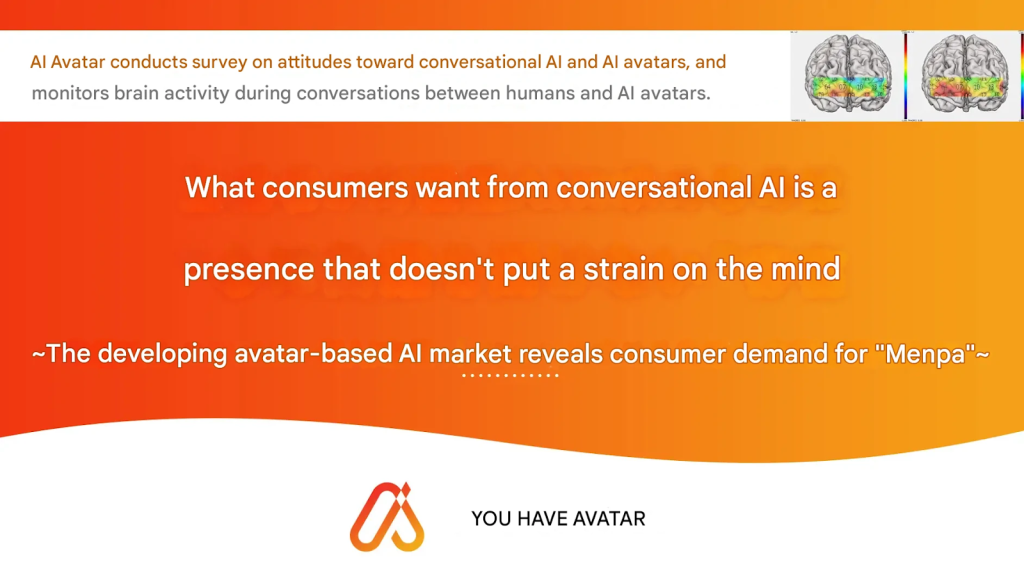
What consumers seek in conversational AI is a presence that “doesn’t burden the heart” — AI Avatar conducts “Survey on Perceptions of Conversational AI and AI Avatar Interaction Experiences” and “Brain Activity Monitoring During Human-AI Avatar Conversations”
-Emerging avatar-type AI market reveals consumer demand for “mental partners”-
AI Avatar Co.,Ltd. (Headquarters: Chiyoda-ku, Tokyo; President: Ichiro Kato; hereinafter “the Company”), which champions itself as your “absolute cheerleader” during your efforts, conducted a survey on the conversation experience with conversational AI and AI avatars among 313 men and women aged 20 to 50 nationwide.
This survey revealed that while conversational AI is used as a means for information acquisition, such as “research and information gathering,” it is also increasingly accepted as a partner to engage with words at one's own pace through uses like casual conversation and sorting out feelings. It also indicated the growing value placed on “mental performance (menpa),” a concept gaining attention in recent years.
Additionally, we conducted a verification study measuring brain activity (oxyhemoglobin changes) during conversations with AI avatars versus human conversations. This explored the potential of AI avatar interactions from both consumer perception and physiological response perspectives.
■Survey on Perceptions of Conversational AI and AI Avatar Interaction Experiences
【Survey Overview】
Sample Size: 313
Sample Criteria: Men and women aged 20s to 50s
Individuals who have previously used “conversational AI like ChatGPT”
Survey Period: Thursday, January 28, 2026 - Sunday, February 1, 2026
Survey Method: Online survey
【Survey Results Summary】
- ChatGPT is the most widely used conversational AI at approximately 63%
- Meanwhile, awareness of character/avatar-type AI exceeds 80%
- Primary purpose for conversational AI use is “research,” but receptive usage also exists
- Compared to human conversation, respondents noted AI allows “talking without worrying about social cues” and “easier expression of true feelings”
- The most common scenario for wanting to converse with avatar-type AI is “when I just feel like talking to someone”
- Sought after during “times when I don't feel like trying hard”
- Expectations lean more towards “companionship” and ‘acceptance’ rather than “instructions/management”
- “Conversations that don't burden the mind”
[Detailed Survey Results]
1. ChatGPT is the most used conversational AI
Meanwhile, awareness of AI avatars exceeds 80%
First, when asked “Which conversational AI have you used in the past?” (multiple answers, n=364), ‘ChatGPT’ was the most common at 62.6%, followed by “Google Gemini” at 42.0%.
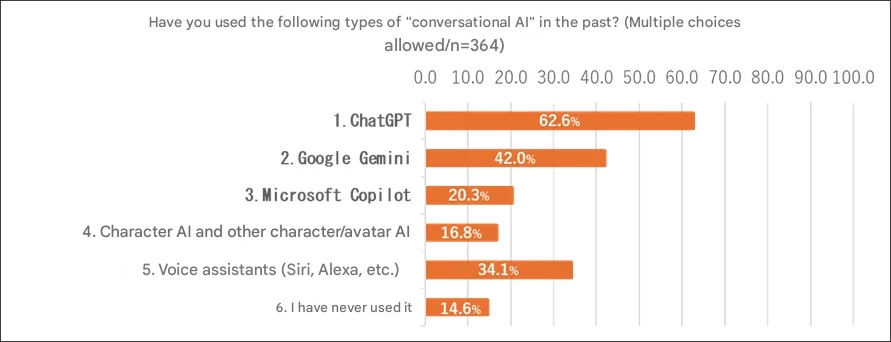
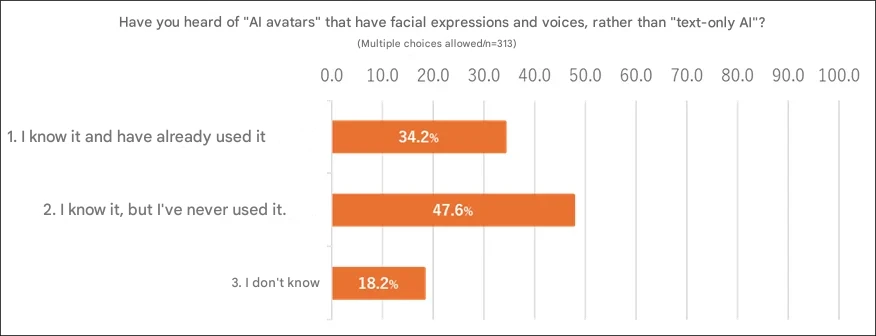
“Character AI and other character/avatar-type AI” remained at only 16.8%. When asked about awareness of “AI avatars with facial expressions and voices” (single answer, n=313), 34.2% responded “I know about them and have already used them,” while 47.6% said “I know about them but have never used them.” This reveals that while usage experience is limited, awareness of their existence is widespread at 81.8%.
2. While “research” is the primary purpose, receptive uses like “casual chat” and “sorting out worries” also have a certain number of users
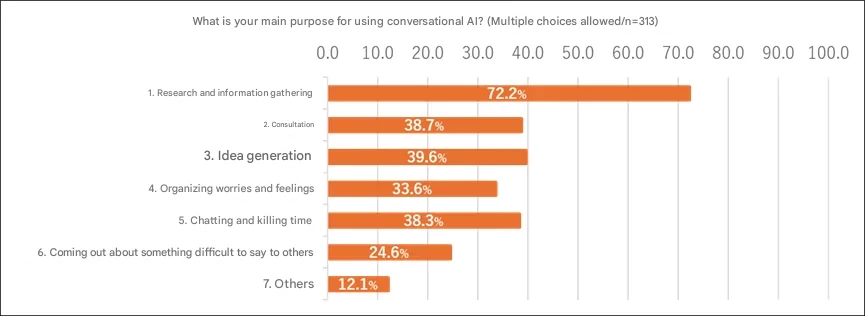
Regarding “Main purposes for using conversational AI” (multiple answers, n=313), “Research/information gathering” was the most common at 72.2%. This, along with the second-ranked “Generating ideas” (39.6%), meant that function-driven uses dominated the top positions.
Other uses included “consultation” (38.7%), “casual chat/passing time” (38.3%), and “organizing worries/feelings” (33.6%), each seen by a significant number of users.
In the “Other” free-response category, answers like “word games or riddles” emerged, suggesting a growing trend of “receptive usage”—where no clear purpose is needed and the premise is simply to be heard by the AI.
3. Compared to human conversation, AI is seen as “easy to talk to without worrying about social cues” and “easy to speak honestly with”
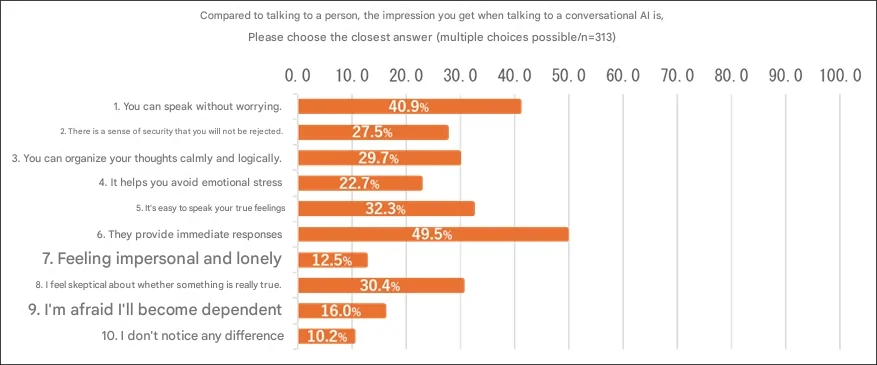
When asked about impressions when talking to conversational AI compared to talking to people (multiple answers, n=313), “Provides immediate responses” (49.5%) accounted for about half. Following this, responses like “I can speak without worrying about offending them” (40.9%), “I can easily speak my mind” (32.3%), and “I feel secure knowing I won't be contradicted” (27.5%) were also prominent. This clearly shows conversational AI is perceived as a partner with whom users feel comfortable expressing their emotions and thoughts candidly.
Simultaneously, a significant number (30.4%) expressed skepticism, stating they “doubt whether it's truly accurate.” This indicates that while conversational AI is valued for its convenience and ease of use, it is still being approached with caution.
4. The most common scenario for wanting to converse with avatar-type AI is “when I just feel like talking to someone.”
They are sought after “when you don't feel like trying hard.”
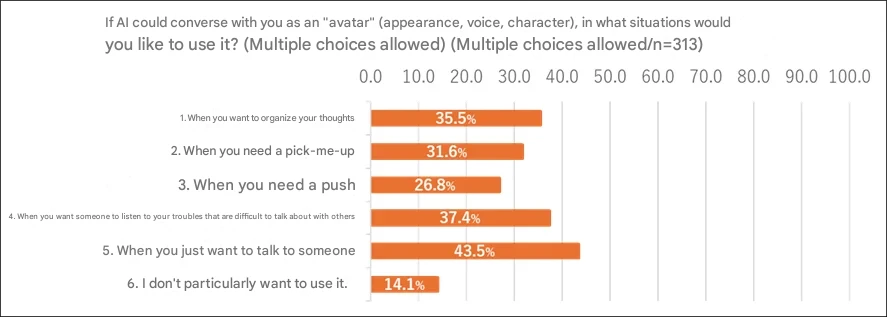
Next, while many people feel conversations with conversational AI have a “positive impact” on their feelings and thoughts (70.2% - single answer), we asked, “If AI could converse with you as an avatar (appearance, voice, character), in what situations would you like to use it?” (multiple answers, n=313).
The most common response was “When I just feel like talking to someone” (43.5%), followed by “When I want someone to listen to troubles I find hard to share with people” (37.4%) and “When I want to organize my thoughts” (35.5%).
These responses suggest that avatar-type AI is sought as a conversational partner during “times when you don't want to push yourself”—moments when people want to shift their mood or adjust their state. Additionally, responses like “When I want encouragement” (31.6%) and “When I need someone to give me a push” (26.8%) indicate expectations for it to serve as a presence helping people take positive steps forward.
5. What's expected is “dialogue that doesn't burden the mind”—like “companionship” and ‘acceptance’—rather than “instructions or management”
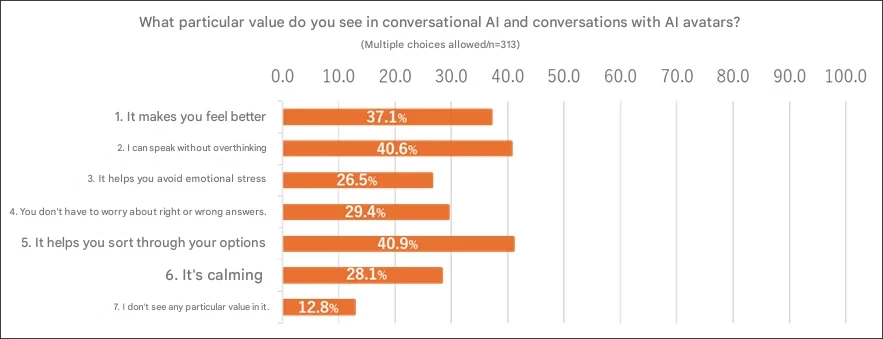
Finally, when asked, "What specific value do you particularly feel from conversations with conversational AI (like ChatGPT) or AI avatars? “ (multiple selections, n=313), responses included ”organizing many options for me“ (40.9%), ”allowing me to talk without overthinking“ (40.6%), followed by ”making me feel more at ease“ (37.1%) and ”freeing me from worrying about right or wrong answers" (29.4%).
Reviewing the expectations and concerns expressed in the open-ended responses revealed opinions such as: “I expect it to serve as a tool for venting honest feelings that are hard to share with people,” “I expect it to allow me to speak honestly and feel lighter,” and “I can be my true self without worrying about being gossiped about or talked about behind my back later.”
These results indicate that conversational AI and AI avatars are expected to serve as “conversation partners that don't impose mental burdens” – entities that listen without judgment or evaluation, embodying qualities like ‘companionship’ and “acceptance,” rather than entities that give instructions or manage.
■Brain Blood Volume Measurement Verification
【Verification Results Details】
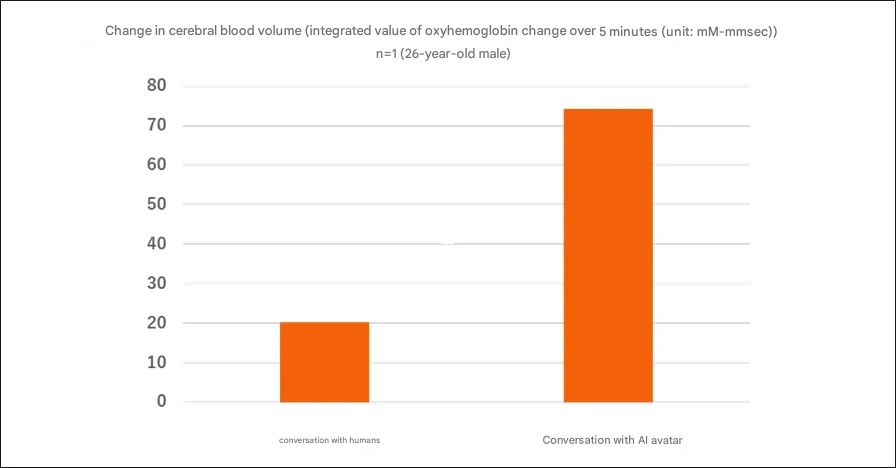
Additionally, to explore how conversations with AI avatars affect human brain activity, a preliminary verification experiment using brain blood volume measurement was conducted under the supervision of Professor Yoshihiko Koga, MD, PhD, Professor Emeritus at Kyorin University.
In this experiment, we measured changes in cerebral blood volume (oxyhemoglobin change values) during conversations with a human and during conversations with an AI avatar, comparing brain responses during each interaction.
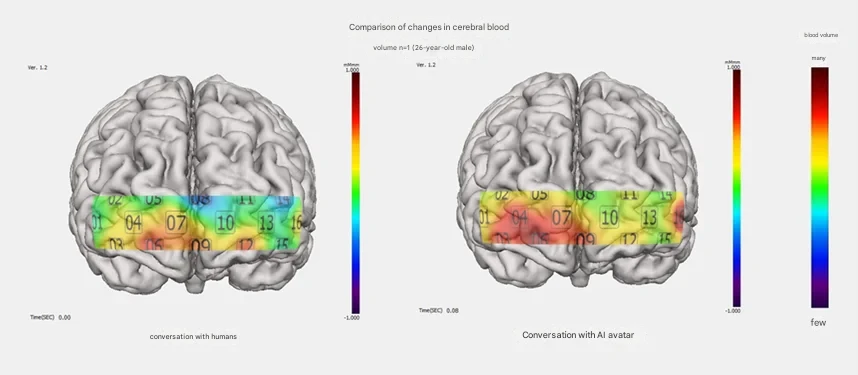
The results showed that, in some subjects, conversations with the avatar activated the frontal lobe of the brain to a degree nearly equivalent to conversations with a real human. This finding suggests the potential for brain activity similar to that experienced during human conversation.
■Potential Applications of AI Avatars Revealed by Research Findings
This research and verification revealed that while conversational AI is primarily used for functional purposes like “research and information gathering,” many people value the ability to speak without reservation and the ease of expressing their true feelings.
Notably, top scenarios for wanting to converse with avatar-type AI included “when I just feel like talking to someone” and “when I want to organize my thoughts,” suggesting a desire for a conversation partner in a “no-pressure state” where evaluation or correct answers aren't expected. Furthermore, responses to conversations with conversational AI and AI avatars increasingly included perceptions like “I can talk without mental strain” and “it makes me feel more relaxed.” This trend likely stems from the growing emphasis on “mental performance” (menpa), a value system gaining attention in recent years that prioritizes reducing emotional exhaustion and fostering mental stability and breathing room.
These results suggest that AI avatars are expected to serve not as entities that give instructions or manage tasks, but as “conversation partners that don't burden the mind”—helping users sort through their feelings and consider their next steps at their own pace.
AI should not replace people, but rather become a presence that supports an environment where people can challenge themselves more authentically. This survey represents a step toward demonstrating that potential.
The AI avatar app “AI AVATAR” is an AI companion that accompanies users on their journey to “become the person they aspire to be,” acting as their “absolute cheerleader for their efforts.” Rather than seeking evaluation or correct answers, it provides a conversational experience that acknowledges feelings and supports progress at one's own pace.
■Comment from Professor Emeritus Koga
Amidst a declining birthrate, the primary expectation for AI avatars is likely their superior information delivery function. The prefrontal cortex is a crucial region in humans, highly developed and responsible for cognition, emotion, and motivation. These results suggest that AI avatars, by activating the prefrontal cortex, not only effectively convey information to conversation partners but also hold potential to serve as communication tools that foster stable emotions and proactivity in the near future.
We anticipate that as the functionality of this AI avatar evolves, it will further contribute to achieving sustainable human well-being.

<Profile>
Yoshihiko Koga (Professor Emeritus, Kyorin University; Psychiatrist; Doctor of Medicine)
Graduated from Keio University School of Medicine. Served as Chair Professor at Kyorin University School of Medicine before assuming his current position. Honorary Member of the Japanese Society for Neurophysiology. Honorary Chairman of the Japanese Society of Hypnosis. Specializes in psychophysiological research on mental disorders and brain imaging studies investigating the effects of scents and foods on brain function.
■About AI Avatar Co,.Ltd.
AI AVATAR GROUP, with bases in seven countries worldwide including Japan and other Asian nations, is a global company focused on developing and providing the conversational app “AI AVATAR” that understands emotions. It works on the social implementation of “companion AI” utilizing multimodal technology (text, voice, facial expressions).
In 2022, it launched its AI Avatar business in Japan. Beyond the “AI AVATAR” app, it is advancing into the medical and education sectors and promoting collaborations with other companies utilizing its technology. With the vision of “a future where AI walks alongside people, continuously supporting their efforts,” the company develops AI avatars that accompany human actions and challenges, encouraging positive steps forward.
As part of these efforts, it offers AI avatar services tailored to specific uses, such as the companion AI partner app ‘SOULRiZA,’ which supports the continuation of actions.
■What is the Conversational AI App “AI AVATAR”?
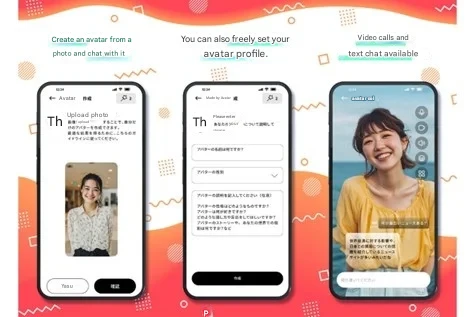
The conversational AI app “AI AVATAR,” provided by AI AVATAR Inc., is designed as an “absolute cheerleader” that continuously supports users' daily efforts and challenges. It reads emotions in real-time from the user's voice tone and facial expressions, responding with words of ‘empathy’ and “encouragement” tailored to their current feelings. Through continuous updates, the AI Avatar evolves beyond a mere conversation partner into a “supporting partner” equipped with personalized features like push notifications and schedule management, supporting users' daily efforts.
Download the app here:
https://apps.apple.com/us/app/ai-avatar-your-companion/id6443651909
【Company Overview】
Company Name: AI Avatar Co,.Ltd.
Representative: Ichiro Kato
Location: 20F Pacific Century Marunouchi, 1-11-1 Marunouchi, Chiyoda-ku, Tokyo
Business Description: Development/Operation/Sales of AI-powered consumer products
Official Social Media
Facebook: https://www.facebook.com/aiavatarjapan
Instagram: https://www.instagram.com/aiavatar_japan/
X: https://x.com/aiavatar_japan
YouTube: https://www.youtube.com/channel/UCTrSAg9bcBaCO6SVoRVPa5Q